
Intellectual Property
Course Overview
Approximately 90% of therapeutics that successfully pass preclinical studies fail to reach the clinic. This course explores the key barriers to clinical translation, with a focus on the business, intellectual property, and market challenges that influence whether a therapeutic reaches patients.
Students will examine the pathway from bench to clinic, including the fundamentals of patenting, the importance of intellectual property protection, and strategies for commercialization. The course also considers how market factors shape the development of new drugs and medical devices, including how potential markets are evaluated.
Through applied learning, students will investigate emerging therapeutics and analyze the scientific, regulatory, and commercial factors that impact their development and translation.
Assignment Highlights
1. Product Market Fit

In this assignment, we evaluated the product–market fit of an emerging healthcare innovation by examining the relationship between a real-world problem, the proposed solution, and the target market. Our group focused on a rapid E. coli detection test designed to address delays in traditional food safety testing methods, which can take days to weeks and increase the risk of contaminated products entering the supply chain .
We analyzed the key stakeholders affected by this problem, including food producers, regulatory agencies, and consumers, and assessed the limitations of current detection methods. We then explored how the proposed technology improves on existing solutions by providing faster, on-site results, ultimately reducing recall risk and improving public health outcomes.
This project strengthened my ability to connect scientific innovation with real-world application by considering not only the biological basis of a technology, but also its market demand, feasibility, and overall value proposition.
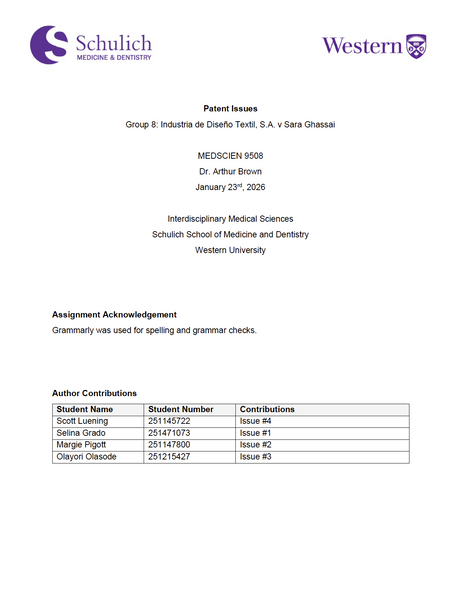
2. Patent Issue
This assignment focused on evaluating the product–market fit of an emerging healthcare innovation by analyzing the relationship between a real-world problem, the proposed solution, and the target market. Our group examined a rapid E. coli detection test designed to address delays in traditional food safety testing, which can take days to weeks and increase the risk of contaminated products entering the supply chain .
We assessed key stakeholders, including food producers, regulatory agencies, and consumers, and evaluated the limitations of current detection methods. The assignment also involved analyzing market demand, customer segments, and the overall value proposition of the technology.
This project strengthened my ability to connect scientific research with real-world application by considering not only the biological basis of a technology, but also its feasibility, market need, and potential impact.
The Intellectual Property course introduced me to the legal and commercial side of scientific research, which was an area I had little exposure to before. It helped me understand that scientific innovation alone is not enough for successful clinical translation, and that factors such as patents, ownership, and market strategy play a major role in whether a discovery reaches real-world application.
Through course assignments, I explored how patents function, why they are important for protecting new therapeutics, and how intellectual property influences decision-making in research and development. I also gained insight into emerging challenges, such as the use of AI in legal and scientific contexts, and the importance of accuracy, accountability, and critical evaluation when using these tools .
Overall, this course broadened my perspective on the pathway from research to application and highlighted the importance of integrating scientific, legal, and business considerations when developing new innovations.